When machinery hums back to life during servicing, the margin for error vanishes. Lockout tagout (LOTO) is the cornerstone of energy control in industrial environments—but it’s not absolute. While OSHA 29 CFR 1910.147 mandates strict procedures for shutting down and isolating machines from hazardous energy sources, certain operations legally and safely fall outside full lockout requirements. Ignoring this nuance leads either to unnecessary operational friction or, worse, dangerous noncompliance.
The real challenge isn’t knowing the rule—it’s knowing when the rule bends. Recognizing valid exceptions to lockout tagout isn’t a loophole; it’s part of mature safety planning. This article breaks down those exceptions, their conditions, and how to implement them without compromising worker safety.
When Lockout Tagout Doesn’t Apply: The Regulatory Framework
OSHA’s LOTO standard is designed for servicing and maintenance tasks where unexpected energization could cause injury. But the regulation explicitly acknowledges scenarios where full lockout isn’t practical—or where alternative protections are equally effective. These exceptions aren’t exemptions from safety; they’re alternate pathways that still require documented procedures, employee training, and risk evaluation.
The core principle: any exception must ensure employee protection equivalent to traditional lockout.
Understanding this distinction prevents two common pitfalls: - Over-application: Stopping production for minor adjustments that don’t require full isolation. - Under-protection: Claiming an exception when real hazard exists.
OSHA outlines specific conditions under which alternative measures are acceptable. The key is justification—not convenience.
Exception 1: Minor Tool Changes and Adjustments
One of the most frequently misunderstood exceptions involves minor servicing tasks that occur during normal production operations.
Scenario: A machine operator needs to clear a paper jam in a printing press or replace a drill bit on a CNC machine. These are routine, repetitive tasks integral to production—not full maintenance.
Conditions for exception: - The task is minor (e.g., less than 10–15 minutes). - It’s part of regular production operations. - The equipment has alternative protective measures (e.g., guards, presence-sensing devices). - The employee remains within immediate control of the machine’s operation.
Practical example: A packaging line operator removes a jammed box using a wooden rod while the machine is in a safe mode enabled by a light curtain. No lockout is required because the safeguard prevents restart during the intervention.
Common mistake: Using this exception for tasks that require reaching into danger zones without effective machine safeguards. If the operator has to bypass a guard, full lockout applies.
This exception relies heavily on machine safeguarding—a complementary layer of protection that makes intermittent access possible without full energy isolation.
Exception 2: Continuous Operation Servicing
with Alternative Protection
Some processes can’t tolerate full shutdowns. In sectors like food processing, chemical manufacturing, or wastewater treatment, stopping equipment frequently can damage product integrity or create new hazards (e.g., solidification in pipes).
Acceptable alternative: Use of a documented, OSHA-recognized alternative procedure that provides equivalent protection.
Requirements: - A written energy control program specific to the task. - Utilization of control methods such as: - Block valves with verification - Double block and bleed systems - Blinding or spading - Positive isolation with pressure testing - Continuous monitoring by trained personnel
Real-world case: A technician inspects a filter in a chemical reactor while the system remains pressurized. Instead of full lockout, they isolate the filter with dual block valves, bleed the line, and verify zero energy with calibrated instruments. This is permitted under OSHA if the procedure is documented and employees are trained.
Risk factor: Complacency. Teams may treat alternative procedures as “easier” without maintaining the same rigor as lockout. The safety level must be identical—even if the method differs.
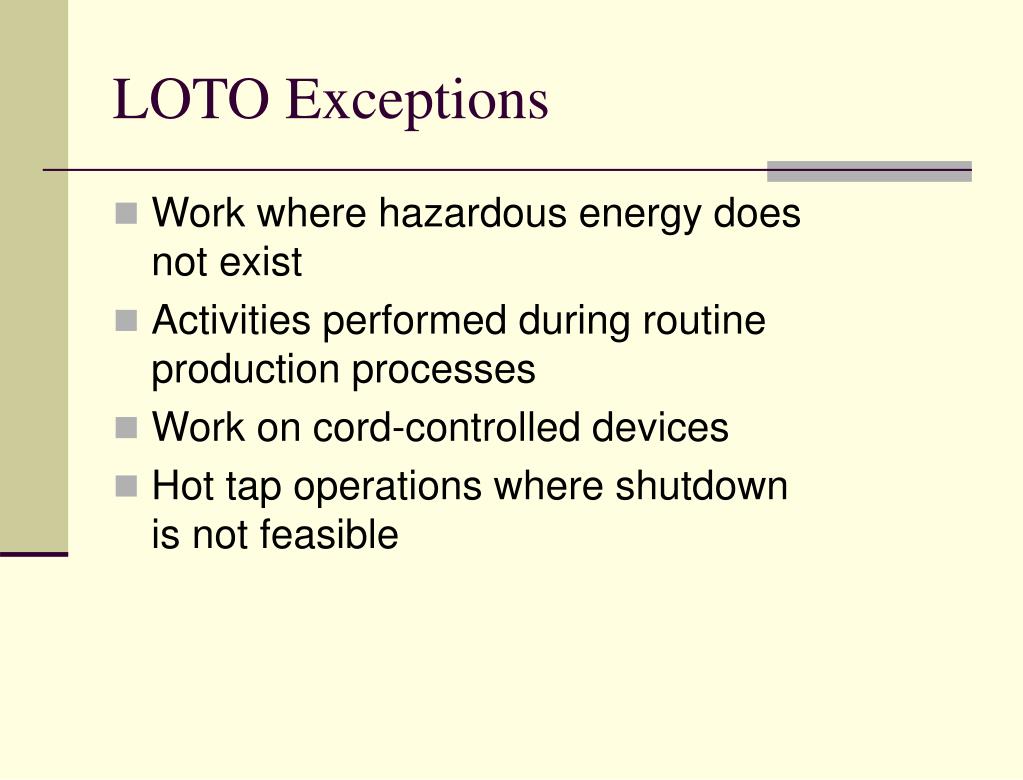
Exception 3: Hot Tap Operations in Transmission Systems For utility and pipeline workers, shutting down lines isn’t always an option. Hot tapping—drilling into live gas or liquid lines—falls under a recognized exception when justified.
OSHA allows hot tap operations without full lockout if: - The pipe material is ductile (not brittle). - The system operates at low pressure (specific thresholds apply). - Procedures address fire protection, sparking risk, and leak response. - Only trained and authorized employees perform the task.
Industry application: A natural gas utility performs a live connection to a distribution line to add a new service leg. Using specialized clamps and tapping machines, crews safely drill into the line without depressurizing.
Critical limitation: This exception doesn’t apply to electrical or mechanical systems. It’s specific to linear transmission systems with continuous flow.
Failure to follow protocol here can lead to catastrophic failure—making documentation and drills non-negotiable.
Exception 4: Set-Up Activities on Production Equipment
Machine set-up during changeovers often blurs the line between operation and maintenance.
OSHA clarifies: If set-up work is preliminary to production and performed by operators using production controls, full lockout may not be required—provided the activity is routine and the risk is controlled.
Conditions: - Activities are part of initial preparation, not repair. - Employees use production controls (e.g., jog mode, inching). - Safeguards like two-hand controls or gate interlocks are active. - The work doesn’t require removing guards or accessing hazardous zones.
Example: Adjusting guides on a metal stamping press using inch mode while the safety gate interlock prevents full cycle operation.
Where it goes wrong: When set-up requires reaching into the point of operation. At that point, even if it’s “just to align a part,” lockout applies. The distinction isn’t the task—it’s the exposure to hazardous energy.
Many injuries occur during set-up because supervisors misclassify tasks as “routine” when they’re actually maintenance in disguise.
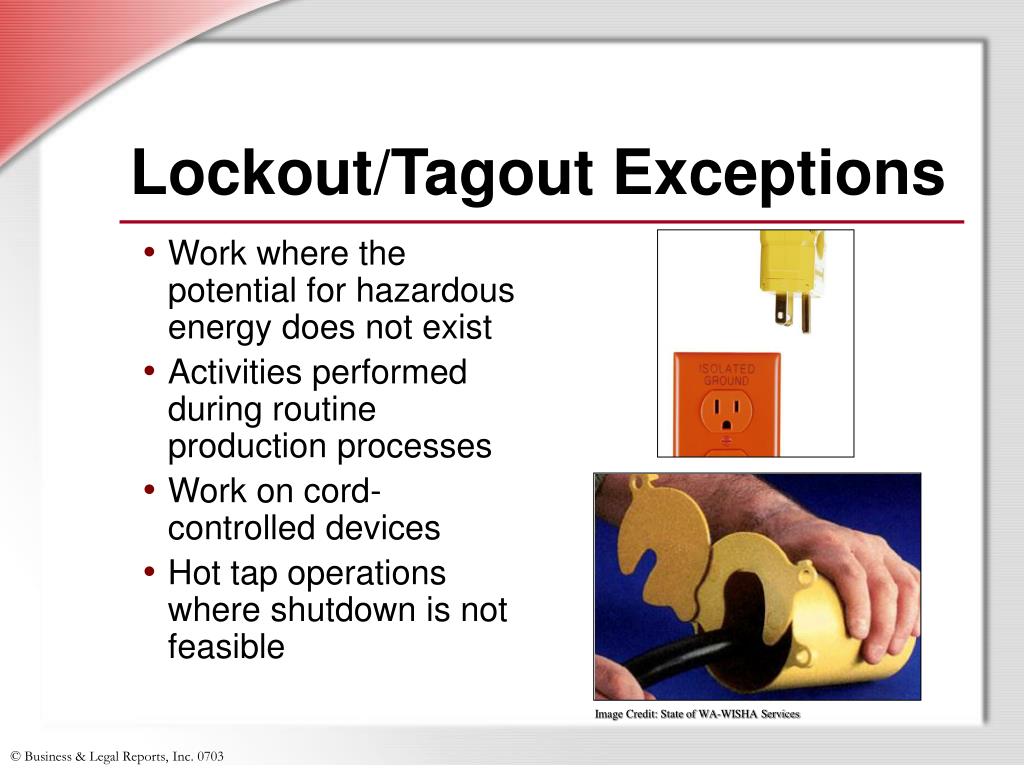
Exception 5: Corded Portable Tools in Controlled Environments
Portable electric tools—drills, grinders, sanders—are often excluded from formal LOTO because of their plug-based energy source.
Why? OSHA considers unplugging a portable tool and retaining control of the plug to be an effective energy isolation method—no formal lockout procedure needed.
But only if: - The plug is within the employee’s immediate control. - No other worker can re-energize it. - The task requires servicing (e.g., changing a blade or bit).
Cautionary tale: A mechanic removes a grinder’s wheel while the tool is unplugged, but leaves the plug in an outlet across the shop. Another worker plugs it in unknowingly. The tool isn’t locked out, and the lack of control violates the exception condition.
This exception collapses the moment control of the plug is lost. The solution? Use a lockout-compatible plug or verify no re-energization risk exists.
How to Legally and Safely Apply LOTO Exceptions
Recognizing an exception isn’t enough—you must manage it systematically.
- Step-by-step best practices:
- Document every exception in your energy control program.
- Train affected employees on when and how exceptions apply.
- Conduct periodic audits to ensure tasks aren’t misclassified.
- Verify safeguards are functional before allowing exception-based work.
- Review after incidents or near-misses—many reveal improper exception use.
Red flags indicating misuse: - Frequent unplanned downtime due to jams or stoppages being “cleared without lockout” - Maintenance teams bypassing LOTO because “it’s just a quick fix” - Lack of written procedures for alternative methods
Your safety culture is only as strong as your weakest exception.
The Role of Management in LOTO Exception Oversight
Managers often push back on LOTO for operational speed. But leadership must enforce discipline—not circumvent it.
Effective strategies: - Include LOTO exception reviews in pre-job safety meetings. - Empower employees to stop work if an exception is being misapplied. - Reward compliance, not shortcuts.
A maintenance supervisor who says, “We don’t have time for lockout,” is creating risk. One who asks, “Is this task eligible for an OSHA-recognized exception—and can we prove it?” is building a safer workplace.
Documentation is your defense. If OSHA shows up, they won’t accept “we’ve always done it this way.” They’ll want procedures, training records, and evidence of equivalent protection.
Final Reality Check: Exceptions Are Not Loopholes
Exceptions to lockout tagout exist to support practical, safe operations—not to bypass safety. The moment an exception is used to save time, avoid paperwork, or keep production running, it becomes a hazard.
Every exception must: - Be justified by OSHA criteria - Be documented in writing - Be understood by all employees - Deliver equivalent protection to full lockout
There’s no such thing as a “minor” injury from a 3,000-pound press cycling unexpectedly. The cost of one incident dwarfs any productivity gain from skipping procedures.
Take Action: Audit Your Exception Practices
Don’t wait for an inspection or incident to review your LOTO program. Start today: - Pull your energy control procedures and highlight where exceptions are used. - Shadow employees during set-up, clearing jams, and servicing tasks. - Verify that safeguards are in place and functional. - Update training materials to clarify the line between eligible and non-eligible tasks.
Safety isn’t about doing less—it’s about doing the right thing, every time.
FAQ
Can I skip lockout if the machine is off? No. Many injuries occur when machines are “off” but still energized. Lockout ensures zero energy. Exceptions require specific safeguards.
Are robotics exempt from LOTO? No. Robotic cells must be locked out during maintenance. However, minor adjustments during production may qualify under the minor servicing exception if safeguards are active.
Do service technicians need to follow LOTO? Yes, unless the work falls under a valid exception and equivalent protection is in place.
Can we use tagout alone without lockout? Tagout alone is allowed only if the equipment can’t be locked out. A hasp or lockable device must be used whenever possible.
What’s the penalty for misusing LOTO exceptions? OSHA fines can exceed $100,000 per violation if willful or repeated. More critically, worker safety is compromised.
Is LOTO required for preventive maintenance? Yes. Preventive maintenance is a servicing activity and requires full lockout unless it qualifies under a specific exception.
Who determines if an exception applies? The employer, through a documented hazard assessment and alignment with OSHA criteria—not individual workers.
FAQ
What should you look for in Exceptions to Lockout Tagout You Need to Know? Focus on relevance, practical value, and how well the solution matches real user intent.
Is Exceptions to Lockout Tagout
You Need to Know suitable for beginners? That depends on the workflow, but a clear step-by-step approach usually makes it easier to start.
How do you compare options around Exceptions to Lockout Tagout You Need to Know? Compare features, trust signals, limitations, pricing, and ease of implementation.
What mistakes should you avoid? Avoid generic choices, weak validation, and decisions based only on marketing claims.
What is the next best step? Shortlist the most relevant options, validate them quickly, and refine from real-world results.