Failing to isolate machinery kills. Every year, preventable accidents in UK workplaces stem from improper maintenance procedures—often because energy sources weren’t reliably controlled. The lockout tagout procedure UK mandates is not just best practice; it’s a legal requirement under the Health and Safety at Work Act 1974 and the Provision and Use of Work Equipment Regulations (PUWER). Yet confusion persists about how it should be implemented, who’s responsible, and what constitutes a compliant process.
This guide cuts through the ambiguity. You’ll learn the exact steps of an effective lockout tagout (LOTO) procedure in the UK context, common compliance pitfalls, and how to build a system that protects workers and satisfies inspectors.
What Is Lockout Tagout in the UK?
Lockout tagout (LOTO) is a safety procedure used to ensure dangerous machinery is properly shut off and cannot be restarted before maintenance or servicing is complete. In the UK, while the term “lockout tagout” is borrowed from American standards like OSHA’s, the principle aligns with British health and safety law focused on safe isolation.
The core idea is simple: when someone works on equipment, all energy sources—electrical, hydraulic, pneumatic, thermal, or gravitational—must be physically isolated and secured. A lock prevents re-energisation, while a tag explains why the lock is in place and who applied it.
Unlike informal shutdowns—such as flipping a switch or pressing an emergency stop—LOTO is a documented, auditable process. It’s not optional for high-risk environments like manufacturing plants, utilities, food processing units, or construction sites.
Legal Framework Behind LOTO in the UK
There is no standalone "LOTO regulation" in UK law. Instead, the requirement emerges from several overlapping health and safety statutes:
- Health and Safety at Work etc. Act 1974: Imposes a general duty on employers to ensure, so far as reasonably practicable, the safety of employees.
- Management of Health and Safety at Work Regulations 1999: Requires risk assessments that include hazardous energy during servicing.
- Provision and Use of Work Equipment Regulations (PUWER) 1998: Mandates safe maintenance procedures and effective isolation.
- Electricity at Work Regulations 1989: Requires precautions against live electrical work.
- Work at Height Regulations 2005 and others: Apply where isolation supports broader safety measures.
HSE guidance documents—such as HSG253: Maintaining Simple Machines and INDG229: Safe Isolation Procedure—are non-binding but heavily influence enforcement. If you ignore these, you’re likely breaching the law.
The key takeaway: lockout tagout isn’t a suggestion. It’s embedded in UK law through the principle of safe isolation.
Step-by-Step Lockout Tagout Procedure UK
An effective LOTO process isn’t just about applying a lock—it’s a sequence of actions designed to eliminate human error. Here's the full cycle used across compliant UK operations:
1. Notify Affected Personnel
Before starting, alert everyone who uses or operates the equipment. This prevents someone from unknowingly trying to restart machinery during servicing.
Example: In a packaging line, supervisors must inform line workers that the conveyor will be down for 45 minutes due to motor maintenance.
2. Shut Down Equipment Properly
Use normal stopping procedures. Emergency stops should not be relied on as isolation points.
Best Practice: Follow machine-specific shutdown sequences. A CNC press may require depressurising hydraulics before powering down.
3. Isolate All Energy Sources
Locate and operate all isolation devices: - Electrical: Circuit breakers, isolation switches - Hydraulic/Pneumatic: Valve closures, bleed points - Mechanical: Spring tension releases - Thermal: Cooling periods - Gravitational: Supports or blocks under suspended loads
Never assume one switch cuts all power. Complex machines often have multiple inputs.
4. Apply Lockout Devices
Each authorised person applies their own lock. Multiple workers = multiple locks. Equipment stays locked until every individual removes their lock.
Use lockout hasps or valve locks that accept padlocks. Universal compatibility matters—standard 12mm shackle locks are common.
5. Attach Warning Tags
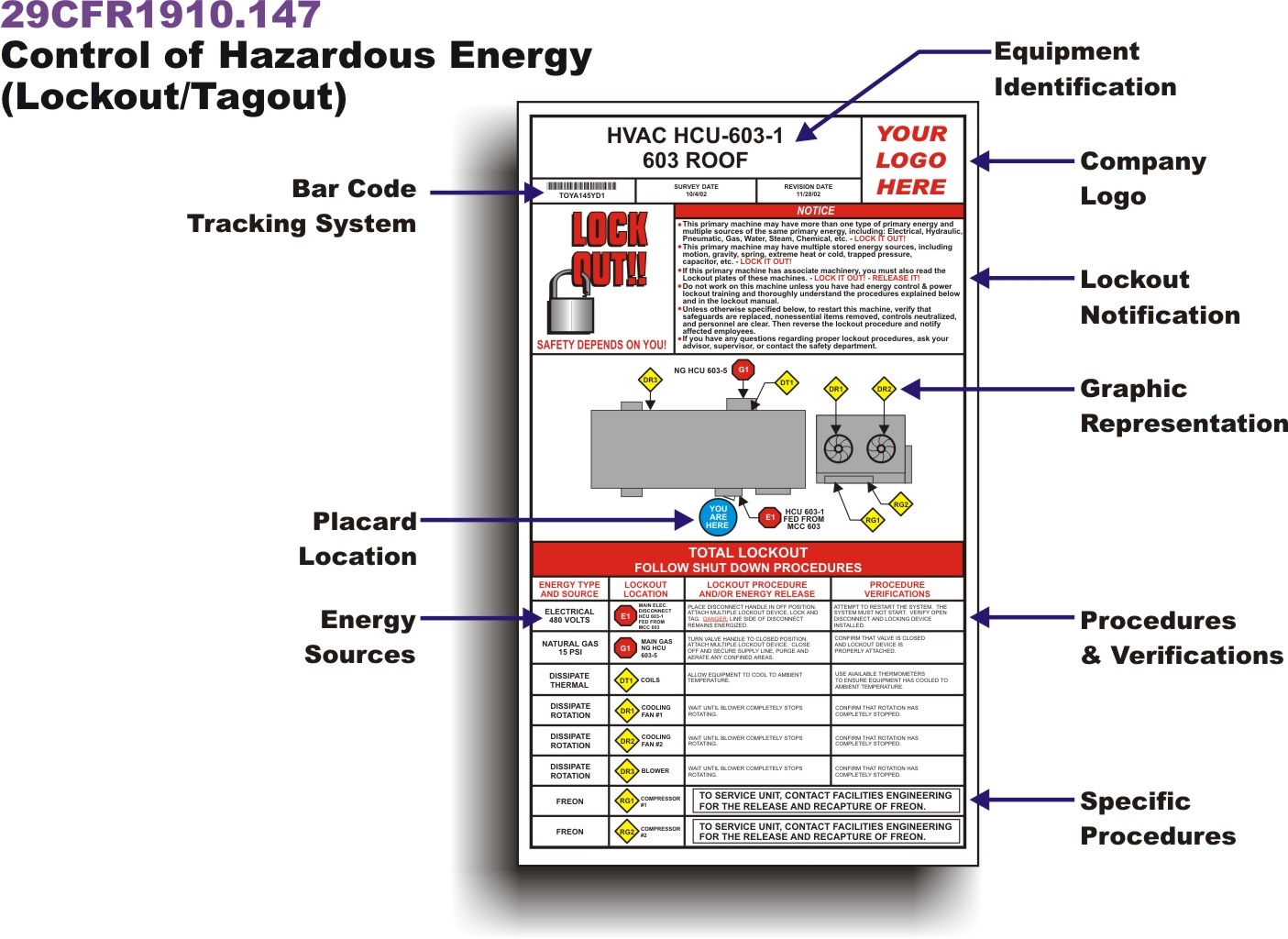
Every lock must have a tag. It should include: - Name of the person who applied it - Date and time - Reason for isolation - Contact information
Tags alone are not enough—without a lock, they’re just warnings.
6. Release Stored Energy
Even after isolation, energy can remain trapped. Examples: - Capacitors holding electrical charge - Compressed air in lines - Suspended counterweights - Hot surfaces
Verify safe discharge using appropriate tools—voltage testers, pressure gauges, or visual checks.
7. Verify Zero Energy State
This is the most critical step—and the one most often missed. Re-energisation attempts must be made to confirm the machine won’t start.
How to verify: - Try to start the machine using normal controls (e.g., press start button) - Do this visibly and deliberately - Ensure no movement occurs
If the machine responds, the isolation failed. Restart the process.
8. Carry Out Maintenance
Only now can work begin. All PPE and task-specific procedures apply.
9. Remove Lockout Devices
After work: - Clear tools and personnel from the area - Reinstall guards and safety components - Each worker removes their own lock - Notify operations team before re-energising
Never remove another person’s lock—even if they’ve gone home. Systems must allow for lock removal under supervision with documented justification.
Who Is Responsible for LOTO Compliance?
Two roles are defined under UK health and safety law:
Authorised Employees These are trained individuals who perform servicing and apply lockout devices. They must understand: - Energy types involved - Isolation points - Use of locks and tags - Verification procedures
Training records must be kept and refreshed regularly.
Affected Employees These are operators who use the equipment but don’t service it. They need to understand: - Why machines are isolated - Not to interfere with locks or tags - The dangers of bypassing safety systems
Supervisors are ultimately accountable for ensuring both groups are trained and procedures are followed.
Common LOTO Failures in UK Workplaces
Even organisations with policies make critical errors. These are the most frequent:
- Using group locks without clear ownership – A single master lock used by a team undermines accountability.
- Skipping verification – Assuming isolation worked without testing.
- Tag-only systems – Relying solely on warning signs without physical locks.
- Inadequate training – One-off inductions with no refresher training.
- Poor lock storage – Lost or shared locks compromise traceability.
- Failure to update procedures – Machinery changes, but isolation methods don’t.
Real incident: In 2022, a maintenance engineer in a Midlands factory was severely injured when a colleague reset a breaker he didn’t know was locked out. The tag was handwritten and faded. No verification had been performed. HSE cited inadequate procedures and poor communication.
Systems fail not because of complexity—but because of complacency.
Equipment You Need for a UK-Compliant LOTO System
To implement LOTO effectively, invest in purpose-built tools:
| Item | Purpose |
|---|---|
| Lockout hasps | Allow multiple locks on one isolation point |
| Valve lockouts | Prevent opening of pneumatic/hydraulic valves |
| Circuit breaker locks | Fit over breakers to prevent flipping |
| Padlocks | Individually assigned, keyed-alike or personal |
| Danger tags | Durable, weather-resistant, with writeable fields |
| Lockout station | Central storage for locks, tags, and logs |
Brands like Brady, Honeywell, and 3M offer UK-compliant kits. But equipment alone won’t ensure safety—procedures and culture matter more.
Real-World Use Cases: Applying LOTO Across Industries
Food Processing Plant A meat slicer requires blade replacement. The operator shuts down the machine, isolates the electrical supply via a local disconnect switch, applies a lock, bleeds residual pressure from the drive system, and tests the start button. Only then does the technician change the blade.
Why it works: Clear isolation points, verification, and individual accountability prevent accidental starts during a high-risk task.
Construction Site Crane Maintenance A tower crane’s slewing motor needs repair. The electrical feed from the site distribution board is isolated at the fuse box. Multiple engineers working on the drive train each apply their own lock. After repairs, each removes their lock only after confirming the area is clear.
Challenge: Remote locations make communication harder. Radio check-ins become part of the LOTO workflow.
Pharmaceutical Manufacturing A mixing vat must be cleaned internally. Before entry, power is cut, agitator locked out, and inlet valves closed and tagged. Confined space entry permits are tied to the lockout process.
Key lesson: LOTO integrates with other safety systems—permit-to-work, confined space, and PPE protocols.
Building a Sustainable LOTO Programme
Compliance isn’t a one-time project. It requires systems that endure:
- Documented procedures for each machine or process
- Regular audits by safety officers
- Training logs showing competence
- Incident reviews when near-misses occur
- Visible leadership—managers applying locks themselves set cultural tone
One UK automotive parts manufacturer reduced maintenance injuries by 78% over three years simply by auditing LOTO compliance monthly and publishing results site-wide.
A strong lockout tagout procedure UK demands is more than a checklist—it’s a commitment to treating energy control as a life-critical process. It’s about designing workflows so that safety isn’t left to memory or goodwill. Whether you manage a small workshop or a multi-site operation, the cost of failure is too high to gamble.
Start today: audit one machine’s isolation process. Verify every energy source. Test the system. Train one team. Scale from there.
Safety isn’t a policy. It’s a practice. And in the UK, it’s the law.
Frequently Asked Questions
What is the difference between lockout and tagout in the UK? Lockout physically prevents energy re-activation using a lock. Tagout uses a warning tag only. Tagout alone is insufficient unless combined with lockout—tags can be ignored or removed.
Do all machines in the UK need a lockout tagout procedure? Not all, but any equipment with hazardous energy during servicing does. Risk assessments under PUWER or the Management Regulations determine necessity.
Can someone else remove my lock during LOTO? Only under controlled conditions—typically when you’re unavailable and a formal override procedure is followed, including management approval and safety checks.
Are LOTO procedures required for electrical work only? No. LOTO applies to any energy source—mechanical, hydraulic, pneumatic, chemical, or gravitational—not just electrical.
Is LOTO legally required in the UK? While not named explicitly, the requirement for safe isolation is enforced through PUWER, EAWR, and HSWA. LOTO is the accepted method of compliance.
Who conducts LOTO training in UK workplaces? Employers must ensure training is delivered by competent persons, often in-house safety officers or external specialists. Records must be kept.
Can digital LOTO systems be used in the UK? Yes—if they provide equivalent or better control than physical locks and tags. Electronic systems must prevent unauthorised access and include verification steps.
FAQ
What should you look for in Lockout Tagout Procedure UK: A Complete Guide to Compliance? Focus on relevance, practical value, and how well the solution matches real user intent.
Is Lockout Tagout Procedure UK: A Complete Guide to Compliance suitable for beginners? That depends on the workflow, but a clear step-by-step approach usually makes it easier to start.
How do you compare options around Lockout Tagout Procedure UK: A Complete Guide to Compliance? Compare features, trust signals, limitations, pricing, and ease of implementation.
What mistakes should you avoid? Avoid generic choices, weak validation, and decisions based only on marketing claims.
What is the next best step? Shortlist the most relevant options, validate them quickly, and refine from real-world results.