Energy control isn’t a guessing game. One loose valve, an unsecured breaker, or a bypassed disconnect can turn routine maintenance into catastrophe. That’s where lockout tagout cable locks step in—versatile, durable, and designed for real-world hazards where traditional padlocks fall short. These aren’t just accessories; they’re force multipliers in a comprehensive LOTO program, especially in complex or space-constrained environments.
Unlike standard hasp-and-lock setups, cable locks bridge gaps, wrap around irregular components, and adapt to configurations that defy one-size-fits-all solutions. From pipeline valves on offshore platforms to conveyor drive motors in food processing plants, cable-based LOTO devices meet challenges that rigid mechanisms can’t.
This guide breaks down how cable locks function, where they excel, and how to use them correctly—without compromising compliance or safety.
Why Cable Locks Are Essential in Modern LOTO Programs
OSHA’s lockout/tagout standard (29 CFR 1910.147) mandates that machines be isolated from all hazardous energy sources during servicing. The rule is clear, but implementation gets messy. Machines vary. So do lock points.
Standard padlocks require a fixed hasp, a compatible shackle diameter, or a built-in locking feature. Many industrial components—especially older or custom equipment—don’t offer that. Enter cable locks.
Cable locks use a flexible steel-reinforced cable anchored at one end, threaded through isolation points, and locked at the other end with a standard padlock. This flexibility allows them to:
- Wrap around valve handles, control rods, or toggle switches
- Secure multiple energy-isolating devices in sequence
- Fit where rigid shrouds or hasps won’t
- Support group lockout procedures with multiple padlocks
A plant technician maintaining a hydraulic press, for example, may need to secure both the main power disconnect and the hydraulic release valve. One lock won’t suffice. A cable lock can loop through both, creating a single, verifiable isolation point accessible to all authorized personnel.
How Lockout Tagout Cable Locks Work
Cable locks consist of three core components:
- Reinforced Steel Cable – Typically 1.5mm to 3mm in diameter, with a nylon or PVC coating to resist abrasion and corrosion.
- Fixed Anchor Head – A molded or metal termination point that prevents the cable from retracting.
- Locking Mechanism – A locking sleeve, cam-lock, or locking head that cinches the cable when a padlock is inserted.
When engaged, the cable is threaded through or around the energy-isolating device (e.g., a closed valve handle), pulled taut, and secured. The locking head prevents slack, eliminating tampering or accidental release.
Some models feature retractable cables for easier storage, while others offer adjustable tension for repeated use. High-end versions include built-in tag holders, UV-resistant coatings, or dual-locking heads for redundancy.
Crucially, cable locks don’t replace padlocks—they complement them. The padlock remains the personal control device, ensuring only the authorized employee can remove the lock.
Common Applications and Real-World Use Cases
Cable locks shine where geometry defeats conventional hardware. Consider these scenarios:
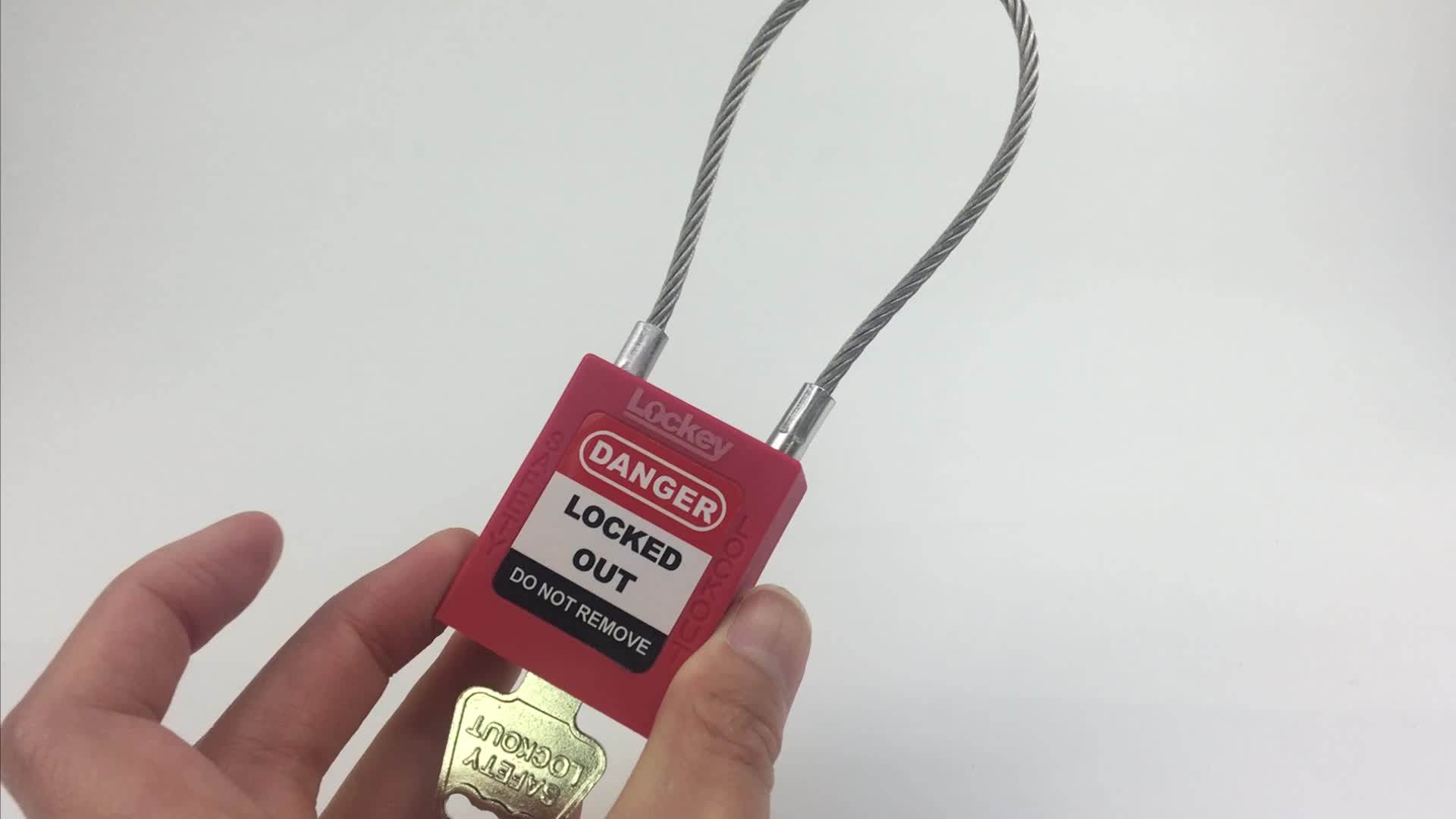
#### Valve Isolation in Confined Spaces A maintenance team working on a steam line must secure a quarter-turn ball valve. The handle is short and angled, with no locking hole. A rigid lockout device won’t fit. A 1.8mm-diameter cable lock wraps snugly around the handle, cinches tight, and accepts a 1-inch padlock. The tag clearly states: “Do Not Operate – Pump Maintenance in Progress.”
#### Circuit Breaker Bundling In a data center’s electrical room, a dual-panel upgrade requires isolating four adjacent circuit breakers. Using individual breaker locks is time-consuming and clutters the panel. Instead, a technician uses a 24-inch cable lock to loop through each handle in the “off” position. One cable, four breakers, one personal lock—verified and visible.
#### Group Lockout During Multi-Craft Repairs When a production line shutdown involves electricians, mechanics, and hydraulics technicians, each must apply their own lock. A cable lock with a multi-lock adapter (like a hasp or lockout block) allows all workers to secure the same cable, ensuring no single person can restart the system prematurely.
These aren’t edge cases—they’re daily realities in manufacturing, utilities, and transportation sectors. Cable locks turn awkward, high-risk situations into standardized, auditable procedures.
Choosing the Right Cable Lock: Key Features to Consider
Not all cable locks are built alike. Selecting the wrong one can lead to failure under stress or non-compliance during audits. Here’s what matters:
- Cable Diameter and Strength
- Thicker cables (2.5–3mm) resist cutting and abrasion but are less flexible. Thin cables (1.5–2mm) fit tighter spaces but may fray over time. Match the diameter to the environment—harsh industrial zones need heavy-duty specs.
- Length
- Standard lengths range from 6 inches to 48 inches. Shorter cables reduce slack and tampering risk; longer ones offer reach but require careful routing.
- Temperature and Chemical Resistance
- Facilities with caustic washdowns (e.g., food processing) need UV-stable, chemical-resistant coatings. Nylon-sheathed cables outperform standard PVC in such environments.
- Lock Compatibility
- Ensure the locking head accepts common industrial padlocks (7/16” shackle diameter is standard). Some heads include universal slots; others are brand-specific.
- Visibility and Tag Integration
- Bright colors (red, yellow) improve visibility. Built-in tag holders ensure warning information stays attached.
- Reusability vs. Single-Use
- Most are reusable, but tamper-evident single-use versions exist for high-security or audit-heavy settings.
Top 5 Lockout Tagout Cable Locks in the Industry
Choosing reliable equipment matters. Here are five widely trusted options, each excelling in specific environments:
| Model | Cable Length | Diameter | Key Strength | Best For |
|---|---|---|---|---|
| Grace Technologies CableLOK® II | 12", 24", 36" | 2.4mm | High-tensile steel core, UV-resistant jacket | General industrial, outdoor use |
| Safetectors SCBL Series | 6" to 48" | 1.8mm | Lightweight, flexible, cost-effective | Tight spaces, indoor facilities |
| Seton Cable Lockout Device | 24" | 2.5mm | Dual-lock head, accepts two padlocks | Group lockout, shared maintenance |
| RS Components Reel-Type Cable Lock | 30" retractable | 2mm | Spring-loaded reel, compact storage | Mobile teams, toolkits |
| Master Lock 4680DAT | 24" | 2.4mm | Durable nylon coating, integrated tag holder | High-visibility, compliance audits |
Each of these supports OSHA and ISO 45001 compliance when used correctly. The choice depends on daily use case, team size, and environmental stress.
Common Mistakes That Undermine Cable Lock Effectiveness
Even the best tools fail when misused. Watch for these frequent errors:
- Allowing Excess Slack
- A loose cable can be manipulated or bypassed. Always pull taut before locking.

- Using Damaged or Frayed Cables
- Cuts, kinks, or exposed steel compromise integrity. Inspect before each use.
- Skipping the Tag
- A lock without a tag violates LOTO protocol. Tags must include name, date, reason, and department.
- Sharing Locks or Keys
- Personal locks are non-transferable. If a worker loses their key, follow the facility’s locked-key protocol—never cut the lock without authorization.
- Improper Routing
- Cables should not drape across walkways or get caught in moving parts. Plan placement carefully.
One Midwest refinery learned this the hard way when a frayed cable lock failed during a pressure test, leading to an uncontrolled release. Audit later revealed repeated use of worn cables and missing tags—correctable issues that cost $300K in downtime and fines.
Integrating Cable Locks into Your LOTO Workflow
Cable locks should be part of a documented energy control process, not an afterthought. Follow these steps:
- Identify Isolation Points
- Map all energy sources: electrical, pneumatic, hydraulic, mechanical, thermal.
- Determine Suitability
- Use cable locks only where they provide secure, tamper-resistant isolation.
- Train Authorized Employees
- Ensure all users understand how to inspect, install, and remove cable locks safely.
- Include in Periodic Inspections
- OSHA requires annual LOTO audits. Check cable condition, usage patterns, and compliance.
- Store Properly
- Keep in labeled, accessible kits—away from heat, moisture, and foot traffic.
A paper mill in Georgia cut LOTO incidents by 70% in 18 months simply by standardizing cable lock use and adding visual checklists to maintenance routines.
Final Thoughts: Flexibility Without Compromise
Lockout tagout cable locks aren’t a workaround—they’re a strategic upgrade. They extend the reach of your safety program into areas that rigid hardware can’t touch, without sacrificing control or compliance.
When selected wisely and used correctly, they reduce human error, speed up isolation procedures, and strengthen accountability. In the hierarchy of hazard controls, cable locks sit firmly in the “engineering controls” tier—proactive, reliable, and essential.
Equip your team with durable, well-designed cable locks. Train them rigorously. Audit consistently. Because when the machine stops, the last thing you want is doubt about whether it’s truly locked out.
Frequently Asked Questions
Can cable locks be used on electrical panels? Yes, as long as the cable securely immobilizes the breaker or disconnect in the “off” position and doesn’t interfere with panel closure.
Are cable locks reusable? Most industrial-grade cable locks are reusable if inspected and maintained. Discard if frayed, kinked, or damaged.
Do cable locks meet OSHA standards? Yes, when used as part of a compliant LOTO program. OSHA doesn’t specify lock type—only that isolation be reliable and under worker control.
How do I prevent tampering with cable locks? Use thick, abrasion-resistant cables, minimize slack, and pair with high-security padlocks. Consider tamper-evident models for critical systems.
Can multiple workers use the same cable lock? Yes—via a group lockout hasp or adapter attached to the cable, allowing each worker to apply their personal lock.
What length cable lock do I need? Measure the path around the component. Add 2–3 inches for tension. Common lengths are 12", 24", and 36".
Are there temperature limits for cable locks? Standard models work from -20°F to 180°F. High-temp variants with silicone or PTFE jackets operate up to 400°F.
FAQ
What should you look for in Lockout Tagout Cable Locks: Secure Energy Isolation? Focus on relevance, practical value, and how well the solution matches real user intent.
Is Lockout Tagout Cable Locks: Secure Energy Isolation suitable for beginners? That depends on the workflow, but a clear step-by-step approach usually makes it easier to start.
How do you compare options around Lockout Tagout Cable Locks: Secure Energy Isolation? Compare features, trust signals, limitations, pricing, and ease of implementation.
What mistakes should you avoid? Avoid generic choices, weak validation, and decisions based only on marketing claims.
What is the next best step? Shortlist the most relevant options, validate them quickly, and refine from real-world results.