Every year, hundreds of workers suffer serious injuries—or worse—because machinery was accidentally re-energized during maintenance. A conveyor belt kicks on mid-repair. A hydraulic press cycles unexpectedly. A chemical valve opens while a technician is inside a tank. These aren’t rare anomalies. They’re preventable tragedies rooted in one failure: the absence of a proper lockout tagout procedure.
So, what is lockout tagout significado in practical terms? It means more than just a translation. It refers to a standardized safety process used to isolate hazardous energy sources and prevent accidental startup of machinery during servicing or maintenance. Known commonly as LOTO, this protocol is not optional in high-risk industries—it’s a lifeline.
Lockout tagout significado goes beyond words. It’s about control, responsibility, and survival in environments where a split-second lapse can be fatal.
The Core of Lockout Tagout: Control Over Hazardous Energy
Machines don’t just run on electricity. They operate using hydraulic pressure, pneumatic systems, chemical reactions, thermal energy, and gravitational force. Left uncontrolled, any of these energy sources can turn a maintenance task into a disaster.
Lockout tagout is designed to neutralize that risk. At its core:
- Lockout means physically securing an energy-isolating device (like a circuit breaker or valve) with a personal lock.
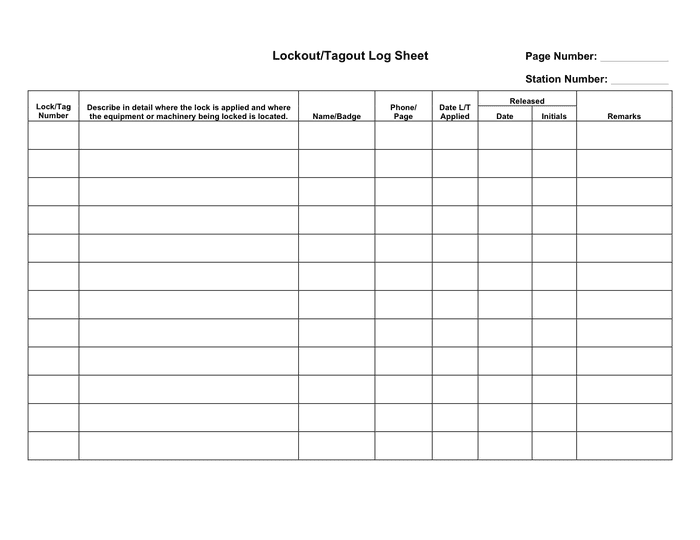
- Tagout involves attaching a warning tag to the locked device, explaining why it’s isolated, who locked it, and when.
Together, they create a fail-safe system ensuring no one can restart machinery while work is in progress.
Real-world example: A maintenance technician needs to replace a motor on a packaging line. Before touching any components, they shut off the main power switch, apply their personal lock, and attach a tag stating “DO NOT OPERATE – MOTOR REPAIR IN PROGRESS – J. MARTINEZ.” Until that lock is removed by Martinez, the machine stays dead.
This isn’t just procedure. It’s protection. And in regulated industries, it’s the law.
Why Lockout Tagout Significado Applies to Every Industry
While LOTO is most visible in manufacturing, its principles apply wherever hazardous energy exists.
Manufacturing Assembly lines, robotic arms, and heavy presses require regular maintenance. One missed lockout step can result in amputations or crush injuries. Common mistake: Group locks used instead of individual locks. Only personal locks ensure accountability.
Chemical Processing Valves control the flow of volatile substances. A tagged shut valve prevents leaks, fires, or explosions. Real case: A worker bypassed a tag to clear a clogged line. Unbeknownst to them, a reactor was still pressurized. The result: a chemical spray causing severe burns.

Utilities and Energy Power plants, water treatment facilities, and electrical substations rely on LOTO to protect crews during outages or repairs. Critical step: Verify zero energy after lockout—never assume the system is safe just because it’s off.
Agriculture Grain elevators, tractors, and irrigation systems all store mechanical or hydraulic energy. LOTO prevents entanglement and unexpected movement.
Even offices aren’t immune. While less common, HVAC maintenance, elevator repairs, or electrical upgrades require the same disciplined approach.
The lockout tagout significado remains consistent: no energy, no movement, no risk.
How OSHA Defines and Enforces Lockout Tagout
In the United States, the Occupational Safety and Health Administration (OSHA) sets the standard for LOTO under regulation 29 CFR 1910.147.
This rule mandates that: - Employers implement a written energy control program. - Each employee receives LOTO training specific to their role. - Periodic inspections (at least annually) verify compliance. - Machines have clearly defined energy-isolating devices.
OSHA doesn’t just recommend this—it audits for it. Companies found non-compliant face fines that can exceed $15,000 per violation. Worse, if an injury occurs due to LOTO failure, penalties can escalate into the hundreds of thousands.
But compliance isn’t just about avoiding fines. It’s about building a culture where safety is non-negotiable.
One auto parts manufacturer reduced maintenance-related incidents by 82% in two years—just by enforcing strict LOTO procedures and retraining supervisors. That’s not luck. That’s leadership.
Common LOTO Mistakes That Undermine Safety
Even when companies have a LOTO program, flaws in execution can render it useless. Here are five real-world mistakes:
- Using Master Keys to Bypass Locks
- Some supervisors carry override keys to keep production moving. This defeats the entire purpose. If a lock can be removed without the worker’s consent, it’s not safe.
- Skipping Verification
- Locking out isn’t enough. Workers must test the machine—press the start button, check pressure gauges—to confirm it won’t activate.
- Tag-Only Systems Without Locks
- Tags are warnings. Locks are barriers. OSHA allows tag-only systems only in rare cases where locks aren’t feasible—and even then, extra safeguards are required.
- Failure to Train Temporary or Contract Workers
- A contractor servicing a boiler isn’t immune to LOTO rules. If they’re not trained and included in the energy control program, the facility remains liable.
- Ignoring Stored Energy
- Springs, flywheels, and capacitors can release energy long after power is cut. A proper LOTO procedure includes steps to safely dissipate or block this residual energy.
These aren’t theoretical risks. They’re holes in the safety net—holes that have led to real injuries.
Implementing LOTO: A Step-by-Step Framework
A successful lockout tagout program isn’t built overnight. It requires policy, training, and discipline. Here’s a practical workflow:
- Conduct an Energy Audit
- Identify every machine and energy source in your facility. Document electrical, mechanical, hydraulic, pneumatic, thermal, and chemical systems.
- Develop Written Procedures
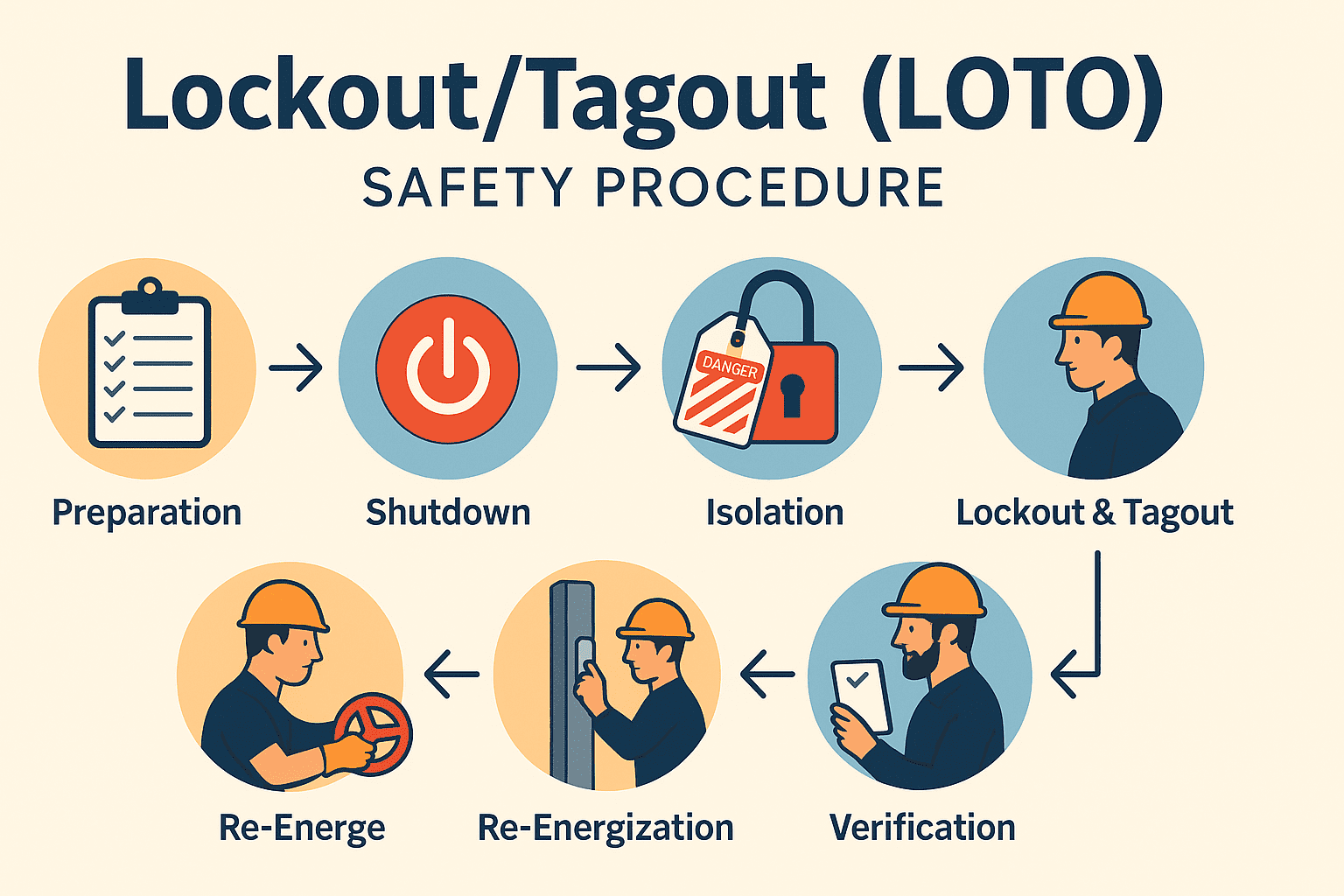
- For each machine, create a step-by-step LOTO guide:
- - Shut down the machine using normal controls.
- - Isolate all energy sources (unplug, close valves, flip breakers).
- - Apply individual locks and tags.
- - Release or block stored energy.
- - Verify isolation by attempting to restart.
- Train Employees
- Authorized employees (those who perform LOTO) need detailed training. Affected employees (those who operate machinery) must understand the process and their role.
- Conduct Annual Inspections
- A supervisor reviews each procedure yearly and observes an employee applying it. Correct deviations immediately.
- Use Standardized Equipment
- Invest in durable hasps, locks, tags, and group lockout stations. Ensure locks are uniquely keyed to individuals.
- Incorporate Shift Changes
- If maintenance spans shifts, the outgoing worker must remove their lock before the incoming worker applies theirs. Never leave a machine in limbo.
This isn’t bureaucracy. It’s operational hygiene.
Real-World LOTO Tools and Equipment
No LOTO program works without the right physical tools. Here are five essential components used across industries:
| Tool | Purpose | Common Use Case |
|---|---|---|
| Personal Safety Locks | Individually keyed locks applied by workers | Electric panel isolation |
| Lockout Hasps | Allows multiple locks on one isolation point | Team maintenance on large machines |
| Valve Lockouts | Secures open or closed valves | Chemical or gas line shutdown |
| Circuit Breaker Locks | Prevents reactivation of breakers | Electrical system maintenance |
| Tagout Tags | Warns others not to operate equipment | Attached with lock, includes name and reason |
These tools are simple, but their consistent use is what prevents accidents. A $10 lock can save a life.
Beyond Compliance: Building a LOTO Culture
The best LOTO programs don’t just meet regulations—they shape behavior.
One aerospace plant introduced “LOTO Champions,” employees who lead safety huddles and audit procedures. They didn’t punish mistakes—instead, they celebrated near-miss reports. Within a year, LOTO compliance rose from 68% to 97%.
Culture shifts happen when: - Leadership visibly follows LOTO procedures. - Workers are empowered to stop work if LOTO is incomplete. - Safety is measured, not just assumed.
When lockout tagout significado is truly understood, it’s not seen as a hurdle—it’s seen as respect. Respect for life, for precision, for the people who keep operations running.
Final Thoughts: Make LOTO a Reflex, Not a Checklist
Lockout tagout isn’t a formality. It’s a fundamental discipline in any environment where machines and humans interact. The term lockout tagout significado captures more than translation—it represents a global commitment to preventing injury through control, clarity, and consistency.
Don’t wait for an incident to validate the importance of LOTO. Start by auditing your current procedures. Train your team. Verify every step. Make it impossible to shortcut the process.
Because when it comes to energy control, there’s no such thing as “almost safe.”
Frequently Asked Questions
What does lockout tagout mean in safety? Lockout tagout is a safety procedure that ensures machines are completely shut off and cannot be restarted until maintenance or servicing is complete.
Is tagout as effective as lockout? Tagout alone is less secure than lockout. Tags are warning devices, not physical restraints. OSHA permits tagout only when locks aren’t feasible, with additional protective measures.
Who is responsible for applying lockout tagout? Authorized employees—those trained to recognize hazardous energy sources and implement the energy control procedure—are responsible for applying LOTO.
Can multiple people work on the same machine using LOTO? Yes. Each worker applies their own lock to a group lockout device. No one can restart the machine until every individual lock is removed.
How often should LOTO procedures be reviewed? OSHA requires that LOTO procedures be inspected at least annually to ensure they’re accurate and being followed.
What happens if someone removes a lockout device early? Unauthorized removal of a lock or tag is a serious violation and can result in disciplinary action, especially if it leads to injury or near-miss incidents.
Do all machines require lockout tagout? Any machine or equipment that could unexpectedly energize, start up, or release stored energy during servicing must be included in a LOTO program.
FAQ
What should you look for in What Is Lockout Tagout and Why It Matters? Focus on relevance, practical value, and how well the solution matches real user intent.
Is What Is Lockout Tagout and Why
It Matters suitable for beginners? That depends on the workflow, but a clear step-by-step approach usually makes it easier to start.
How do you compare options around What Is Lockout Tagout and Why It Matters? Compare features, trust signals, limitations, pricing, and ease of implementation.
What mistakes should you avoid? Avoid generic choices, weak validation, and decisions based only on marketing claims.
What is the next best step? Shortlist the most relevant options, validate them quickly, and refine from real-world results.