Machines don’t warn you before they start. That silence is deadly. Every year, hundreds of workers are injured or killed during equipment servicing—preventable tragedies that happen when energy isn’t properly isolated. The solution? A lockout tagout (LOTO) form. Specifically, a standardized, accessible, and correctly executed LOTO forms PDF used across operations to enforce control over hazardous energy.
These forms aren’t just paperwork—they’re legal safeguards, procedural anchors, and frontline defenses against unexpected startup or release of stored energy. When you download a lockout tagout forms PDF, you’re not just getting a template. You’re implementing a critical component of your facility’s energy control program, one that OSHA mandates under 29 CFR 1910.147.
But not all PDFs are created equal. Generic, incomplete, or poorly structured forms lead to skipped steps, miscommunication, and compliance gaps. This guide breaks down what makes an effective LOTO form, where to find reliable templates, and how to integrate them into real-world maintenance workflows.
Why Lockout Tagout Forms Matter in Energy Control
Lockout tagout procedures exist to isolate all forms of hazardous energy—electrical, hydraulic, pneumatic, chemical, thermal, or mechanical—before maintenance begins. While the lock-and-tag hardware gets the attention, the form documents the process. It answers: - Who initiated the lockout? - What equipment is affected? - Which energy sources were isolated? - When did the lockout begin—and when was it removed?
Without a standardized form, this information lives in memory or verbal handoffs—high-risk for error. A PDF-based LOTO form ensures consistency, creates an audit trail, and supports training and compliance verification.
Facilities using handwritten or ad-hoc forms often struggle during OSHA inspections. A professional, well-structured PDF template eliminates ambiguity and shows regulators you take safety seriously.
Key Elements of an Effective LOTO Forms PDF
A high-quality lockout tagout forms PDF isn’t just a checklist. It’s a structured workflow tool. The best versions include:
1. Header Information
- Facility name
- Date and shift
- Equipment ID and location
- Maintenance team lead
2. Energy Source Identification Section A dedicated table listing each energy type (e.g., 480V electrical, 120 PSI hydraulic) and the corresponding isolation point (circuit breaker, valve, disconnect switch).
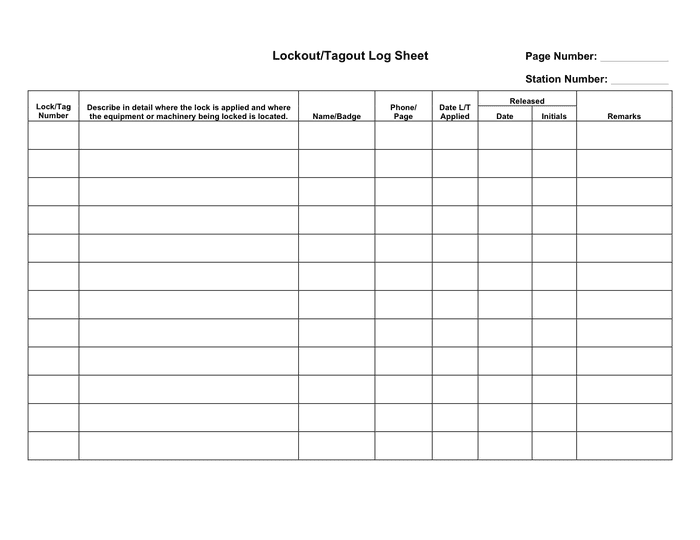
3. Lock Application Log A table for each authorized employee to record:
- Their name
- Lock number
- Tag number
- Type of energy controlled
This creates individual accountability.
4. Verification of Isolation A section for the lead technician to confirm zero energy state using test instruments—this is where most accidents happen if skipped.
5. Sign-Off and Release Authorization Only the original lock applicator should remove their lock. The form must track release timing and verification.
Include fields for supervisor approval and witnessed re-energization where required.
Common Mistakes When Using LOTO Forms PDF
Even with a solid template, misuse undermines safety. Watch for these recurring issues:

❌ Using a Generic Form for All Machines A one-size-fits-all PDF fails when applied to complex systems. A CNC press has different energy points than a conveyor belt. Use equipment-specific forms wherever possible.
❌ Skipping the Verification Step Workers often assume “it’s off” after locking out. But stored energy in capacitors, springs, or elevated parts remains. The form must require positive verification—e.g., “Tested with voltage meter: 0V confirmed.”
❌ Allowing Blank or Unsigned Fields Incomplete forms are non-compliant. Enforce strict completion rules. Digital PDFs with required fields reduce this risk.
❌ Storing Forms in Silos If the LOTO PDF is saved only on one person’s desktop, it’s useless during an audit or incident review. Store completed forms in a central, accessible repository—cloud drive, safety software, or physical logbook.
Where to Find Reliable Lockout Tagout Forms PDF
Not all free downloads are safe to use. Many templates online lack OSHA alignment or critical fields. Here are five reputable sources for trustworthy, customizable LOTO forms PDF:
| Source | Features | Best For |
|---|---|---|
| OSHA Official Website | Basic compliance template, government-vetted | Regulatory alignment |
| NIOSH Workplace Solutions | Industry-specific examples (e.g., manufacturing, labs) | Real-world adaptation |
| EHS software vendors (e.g., Perillon, Cority) | Editable, branded PDFs with audit trails | Enterprise facilities |
| SafetyCulture (iAuditor) | Free downloadable templates, mobile-friendly | On-the-go use |
| ANSI-Z244.1 Compliant Templates (via NEMA) | Matches updated standards for control systems | High-risk environments |
Always customize the form to your equipment. Add photos of isolation points, QR codes linking to SOPs, or equipment schematics directly in the PDF.
Integrating LOTO Forms PDF into Daily Maintenance
A PDF isn’t useful if it’s not used. Build the form into your workflow:
Before Maintenance
- Pull the machine-specific LOTO PDF
- Review energy sources and isolation points
- Brief all affected employees
During Lockout
- Print or open the PDF on a tablet
- Record each lock applied in real time
- Perform verification and sign off
After Completion
- File the completed form
- Log in safety management system
- Conduct a quick debrief if any issues arose
Tip: Use fillable PDFs on tablets in the field. Workers can sign with a stylus, attach photos, and email directly to supervisors. This speeds up reporting and improves data accuracy.
For facilities with rotating shifts, maintain a lockout logbook—a compiled PDF of all active and recent LOTOs—available at control desks.
Equipment-Specific LOTO Forms: Why One Template Isn’t Enough
A boiler, a robotic arm, and a chemical pump each have distinct energy hazards. Your lockout tagout forms PDF should reflect that.
Example: Hydraulic Press vs. Conveyor System
| Criteria | Hydraulic Press | Conveyor System |
|---|---|---|
| Energy Sources | 480V power, 2000 PSI hydraulics, mechanical spring tension | 120V motor, gravity rollers, belt tension |
| Isolation Points | Main disconnect, hydraulic shutoff valve, pressure relief | Motor disconnect, drive chain lock, tension release |
| Verification Method | Pressure gauge = 0 PSI, visual chain inspection | Test run after re-energization (supervised) |
Using the same form for both increases the risk of missing a critical step. Develop machine-specific LOTO forms PDFs and label them clearly in your system.
Digital vs. Paper LOTO Forms PDF: What Works Best
While PDFs are digital files, they’re often printed and used on paper. But the trend is shifting toward interactive digital use.
Pros of Digital PDFs:
- Required fields prevent incomplete forms
- Timestamps and GPS add verification
- Easy to archive and retrieve
- Can integrate with CMMS or EHS platforms
Cons of Paper-Based PDFs:
- Prone to damage in industrial environments
- Hard to search or audit
- No real-time collaboration
For high-volume or regulated environments, invest in digital LOTO solutions that use PDFs as exportable records—but capture data in a secure system first. This gives you the best of both: compliance-friendly reporting and operational efficiency.
How to Customize Your Lockout Tagout Forms PDF
Start with a solid template, then tailor it:
- Add Equipment Diagrams – Insert a small schematic showing isolation points.
- Include PPE Requirements – Specify gloves, face shields, or voltage-rated tools.
- Link to SOPs – Add URLs or QR codes that open related procedures.
- Use Conditional Fields – In editable PDFs, hide/show sections based on equipment type.
- Brand for Your Facility – Add company logo, safety motto, and emergency contacts.
Save versions as: - LOTO_Form_PressLine_A_v2.pdf - LOTO_Form_Chemical_Mixer_2025.pdf
Clear naming prevents confusion.
Final Thoughts: Make Your LOTO Forms PDF a Living Document
A lockout tagout forms PDF shouldn’t be a static file buried in a folder. It’s a dynamic part of your safety culture. Review and update forms annually—or immediately after an incident, near-miss, or equipment upgrade.
Train new hires using actual PDFs from past lockouts. Run drills where teams must locate and complete the correct form under time pressure. Turn compliance into competence.
When done right, your LOTO PDF isn’t just a form. It’s a record of responsibility, a tool for protection, and proof that safety isn’t optional—it’s engineered into every task.
Download, customize, enforce. Then lock it, tag it, and verify it—every single time.
Frequently Asked Questions
Where can I download a free lockout tagout forms PDF? OSHA, NIOSH, and safety platforms like SafetyCulture offer free, downloadable LOTO forms PDFs that are OSHA-compliant and customizable.
Can I edit a lockout tagout forms PDF? Yes—use PDF editors like Adobe Acrobat, Foxit, or online tools to make fillable fields, add logos, or modify sections for your equipment.
Do LOTO forms expire? Not automatically, but they should be reviewed annually or after equipment changes to ensure accuracy and compliance.
Who fills out the LOTO form? Authorized employees performing maintenance are responsible for completing the form, including lock application and verification.
Should LOTO forms be kept on file? Yes—completed forms must be retained as part of your energy control program for audits and incident investigations.
Can digital LOTO apps replace PDF forms? Many apps generate PDFs as final records, offering better tracking and compliance—though the PDF output remains essential for reporting.
Are LOTO forms required by OSHA? While OSHA doesn’t mandate a specific form, documentation of each energy control procedure—including isolation steps and verification—is required.
FAQ
What should you look for in Lockout Tagout Forms PDF: Templates, Uses, and Best Practices? Focus on relevance, practical value, and how well the solution matches real user intent.
Is Lockout Tagout Forms PDF: Templates, Uses, and Best Practices suitable for beginners? That depends on the workflow, but a clear step-by-step approach usually makes it easier to start.
How do you compare options around Lockout Tagout Forms PDF: Templates, Uses, and Best Practices? Compare features, trust signals, limitations, pricing, and ease of implementation.
What mistakes should you avoid? Avoid generic choices, weak validation, and decisions based only on marketing claims.
What is the next best step? Shortlist the most relevant options, validate them quickly, and refine from real-world results.